// The Discipline of No
More money was supposed to buy better decisions. Mostly it buys the excuse to skip making one.
A short one about Seth Godin, Yahoo’s homepage, and why more resources should mean fewer decisions, not more products.
Also: a search box with nothing else on it, a company that said yes to everything, and the part of the job that doesn’t scale with funding.
More
Seth Godin wrote a short piece this week contrasting OpenAI and Anthropic. OpenAI launches everything. Chat, agents, video, robotics, whatever’s next. Anthropic ships less, on purpose. Godin’s line: “There are lots of things you can do, but it’s not clear you should.”
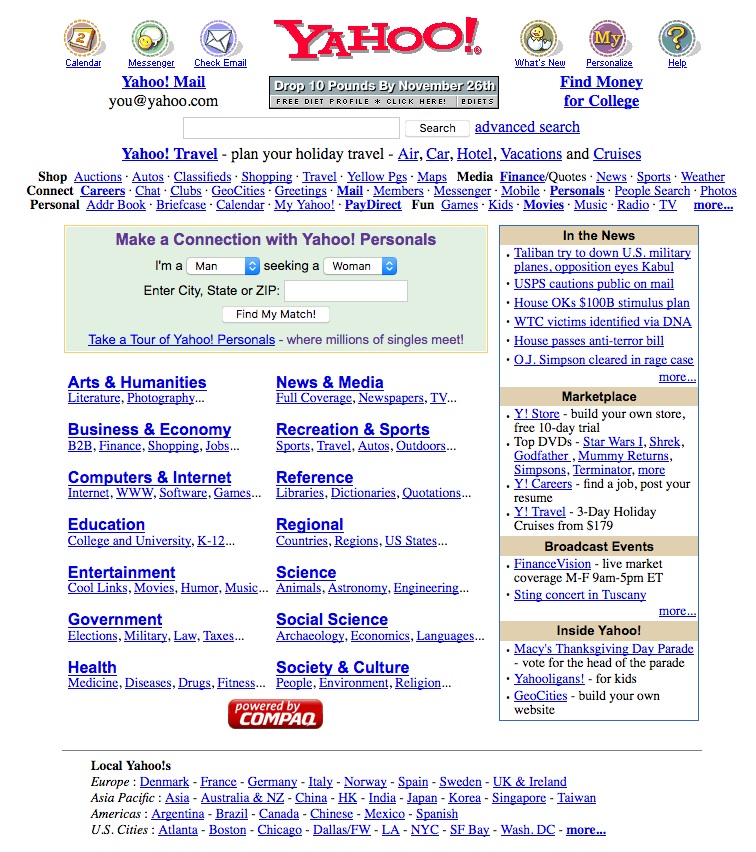
His other example is older. Yahoo’s homepage, at its peak in 2000, was news, horoscopes, games, weather, mail, chat, shopping, stock tickers, all fighting for the same rectangle. Google’s homepage was a box. One thing to do, and one way to do it.
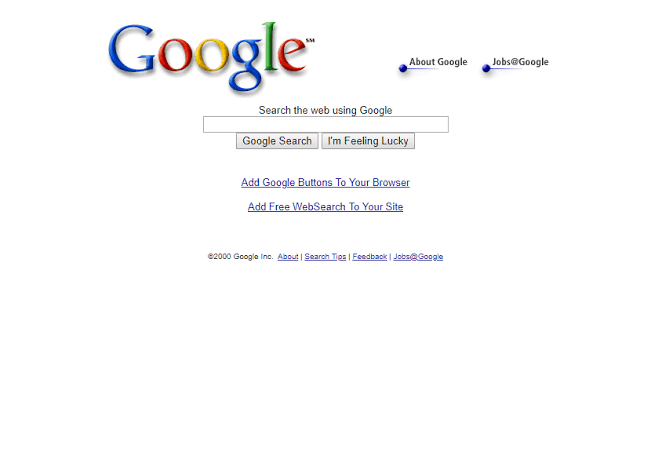
Yahoo had more money than Google for most of that decade. More people. More features. It lost anyway.
The missing decision
I wrote a while back about what removing friction does to a person. One-click purchase, autoplay, the recommendation instead of the search. Each one removes the moment where you had to know what you wanted. The convenience is real. So is the cost: the muscle that forms intent gets used less, and it atrophies.
Resources do the same thing to a company, just from the other direction. A team with no budget has a forcing function built in. Every feature has to earn its place, because there’s no money to build the ones that don’t. A team with plenty of money loses that forcing function. Nothing has to earn anything. “We can afford it” becomes a reason on its own.
I’ve felt this pull from the design side more times than I can count. As a design leader, you spend a lot of your time wanting to build the interesting thing. The new pattern, the delightful interaction, the feature nobody asked for but that would be beautiful to make. Product managers are supposed to be the counterweight. Cold about it. What does this cost in time and engineering. What’s it worth, against everything else that money could go on instead.
When that tension disappears, so does the discipline. A team where nobody’s asking the hard question ends up shipping whatever felt good to make, because nobody was left in the room whose job was to say no.
Both end up removing the same moment: the one where someone had to choose.
Saying no
A narrow product is a decision, stated out loud, about what the thing is for. Anthropic saying no to robotics is a claim. Google’s search box was a claim, defended for years against everyone internally who wanted to add a portal, a news feed, a chat widget.
Yahoo’s homepage was the absence of a decision. Nobody said no to the horoscopes, so the horoscopes stayed. Nobody said no to anything, so everything stayed, and the whole thing collapsed under its own agreeableness.
Saying no is the visible evidence that someone, somewhere, knows what the product is actually for.
The company-sized version
This is the same thing I keep coming back to, just with more money. Without intent, a person’s choices converge toward whatever the algorithm suggests next. Without intent, a company’s roadmap converges toward whatever the market says yes to, which is usually whatever every other well-funded competitor is already building. It collapses toward the average of everything that already exists, one funding round at a time.
More resources should buy you the room to be more precise about what you’re not doing, and put more weight behind what’s left once you’ve said no to everything else. Mostly, it buys sprawl, because sprawl is the path of least resistance once the money removes the reason to say no.
What doesn’t scale
Money buys options. It was never going to supply the missing decision about what to do with them. That part still has to come from someone who knows what the thing is for, and is willing to keep saying no on its behalf.
Whatever you can afford to build, someone still has to curate it down to what’s worth building.
I'd love to tell you more.
Previous Journal Post
// System Personas and UCD
An AI agent doesn’t care about your brand guidelines. It cares whether you’re useful. And how efficient.
User-centered design gets a new kind of user. Not a persona you write for a user, a system standing in the queue as one.
Also: screen readers, search spiders, and a word the web has been using since the nineties without noticing what it meant.