// Tyl by Natwest
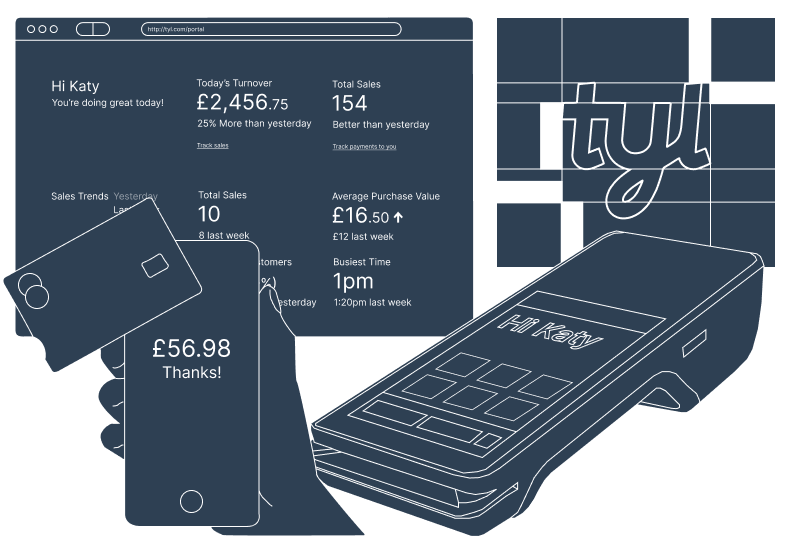 Designing, branding and launching Tyl by Natwest, the platform that allowed NatWest to re-enter the merchant acquiring space.
Client | Pollinate / Natwest
Agency | Class 35
Role | UX Director (Product)
// Challenge
After years of private equity investment and a strategy of pan-regional consolidation and cost leadership, not product innovation - merchant services was in a race to the bottom.
Having been cut out of the lucrative merchant services game for a decade following regulator intervention in 2008, NatWest wanted not only to re-enter the market, but redefine it.
Class 35, partnering with Pollinate, created a merchant services product that is built around the needs of the small businesses that keep the economy moving.
// Multi-Platform

The product consisted of multiple touchpoints working together to create an end-to end experience from discovery through to purchase, onboarding and ongoing use.
Each of these touchpoints had bespoke design and coherent user experience, reflecting the brand and its values at every interaction.
// Onboarding

(Diagram to follow)
At the time we designed Tyl most merchant acquiring products had lengthy and time consuming sign-up / onboarding flows. Complicated legal checks need to happen, so the sign-up process can take hours or days.
We specifically designed Tyl to eliminate this friction, enabling customers to set up an account, and start configuring their merchant portal ahead of the point-of-sale device arriving.
Care and consideration was taken to ensure merchants with multiple locations could pre-configure their point-of sale devices, and have them shipped to the right location, ready for store managers to begin using right out of the box!
// Merchant Portal
 Our research revealed that logging into complex financial systems was a source of anxiety for merchants. Typically they dreaded having to log in and spend valuable time checking numbers to see if anything was wrong.
Most financial portals are designed for infrequent use, of up to hours at a time, but we soon realised we wanted the portal to be useful many times a day - for short periods of time.
So the portal was designed to be glanceable, with a quick overview of financial performance and a clear indicator if there are anything that needs your attention.
If you wanted to deep dive, the information would be there but the initial view would be clean, uncluttered and welcoming.
// Point of Sale
 Tyl’s Point of Sale (POS) was based around terminals manufactured by Clover. Their Flex product was based on a “hardened” Android OS, the apps were all bespoke and the device could be expanded with additional functionality via their proprietarty app store.
No un-vetted third party apps could be installed, for obvious security reasons.
(insert diagram showing fu)
// The Brand
 The initial name for the product tested badly with mechants. A new name was needed - quickly!
After a lengthy process, the name Tyl was chosen.
The term “till” is often used in British English to refer to a cash register or the cash drawer within a cash register. The word “till” has its origins in Middle English and Old English, where it referred to a drawer or box that held valuables or money. Over time, the term evolved to specifically refer to the cash register or the compartment where cash is kept in a business establishment.
Initially we were worried that people would mispronounce the name as “Tile”, but testing with merchants put us at ease. Especially in the context of payments, people defaulted to “Till”.
The logo evolved from a hand-drawn sketch, with the cursive style hiving it a sense of human-ness.
// Marketing Website

// Outcome
Tyl went from Zero to One in 13 Months.
Tyl by NatWest launched in 2019 with 3x leading industry NPS scores.
Pollinate went on to raise $100m in funding and launch Tyl in 3 international markets
Awarded Best Merchant Acquirer in 2022
I'd love to tell you more.
// Dreaming Aloud
My brain started fizzing again. I hadn’t felt that in years.
An old post, brought in from Medium. About noticing the same energy that was around from 2010 to 2014, before the NDAs closed in, and what a Turner Prize-nominated artwork in Eastbourne had to do with getting it back.
Also: a Tumblr notebook, Discordia, and a clock that started all of this.